Happy Easter.
an artists' view
Showing posts with label Geology. Show all posts
Sunday, 20 April 2014
Saturday, 29 June 2013
ammonites
Some public sculpture in Wakefield.
Carvings, with the identifiable spirals of ammonites cut into the stone. I couldn't resist photographing these, being interested in geology. The marks on the stone made by the cutters are lovely, too. Don't know if these were hand or machine cut. But the marks are a connection to the person who made the sculptures, and I like that. Almost as if it's a thumbprint from that artist; a mason's mark. Something of that person, left behind.
I quite fancy going along and making a rubbing of these. Collect those marks onto paper. As I'm using the Labyrinth spiral for my textile course, this sculpture seems to resonate with me. Hard stone; soft fabric. Echo back, amplified.
Saturday, 19 January 2013
winter wonderland
The fence below the railway embankment close to where I live; circa 2009. The flakes then were the big fluffy ones, so we got deep, deep drifts of snow. Deeper than my walking boots, so I often got wet ankles when I was out in it. It's not so deep this time, for which I am thankful.
Wales and the south-west of England have been having a tough time; power cuts etc. Wakefield is on a river plain; a flood plain, so we don't have the hills to catch the snow, as the Pennines do. It tends to melt away fairly fast.
Geography and geology are fascinating subjects. And help us understand what's going on in our locality.
Though the national weather forecast is for snow over most of Britain, local conditions vary according to the geology. Wakefield the town, is fairly flat, although the District of Wakefield has hills around it. We are like the bottom of a bowl, where the river runs through; and small hills rising up from the base. And small outcrops at various spots creating a lumpy landscape.
The embankment creates its own micro-climate, of slope, and flat fields. And the ever-present beck, draining the water away to the River Calder, and ultimately, to the sea.
Sunday, 17 June 2012
Stitching & Dye-ing 2
A 'work in progress' of the organzie overlay of stitched collaged fabric/s. This is the 'top' of the length of organzie. Approximately one third of the length of the whole piece. It's quite a small piece, 28cm wide, and 91cm long. It has an almost three dimensional quality, too, as the organzie puckers and crinkles under the machine stitching.
I like that.
I like that.
Labels:
'sashiko' sewing,
archaeology,
embellishment,
embroidery,
Fabric,
Geology,
landscape,
Overlay,
sewing,
stitches
Saturday, 16 June 2012
Fossil & Printing
My original drawing was from an image of a fossil tree; the lepidodendren which formed the basis of the coal measures.
This print was from an acetate sheet, which I burnt through using my soldering iron (for textiles). It's black paint, onto cotton. And as yet, I'm not sure what the next stage will be. But that's fine; like a lot of the pieces I'm making, I will let it settle, and see what emerges.
I've made a number of these prints, on different fabrics; to see what I can do with them. Overlays (!) and stitching I suspect?
Here at home there's lots of work going on; the roof of the garage needs replacing, so I have lots of clearing out to do, to make it ready for the builder. And I'm having some of the garage converted into a workspace, so I can have a home-based studio to work in. Exciting, and daunting at the same time!
Thursday, 14 June 2012
Stitching & Dye-ing
Using the fabric that I've dyed during the textile course I've been attending, I decided to sew rows of stitches....sashiko-style.....The blue/pink fabric is dyed using procion dye; the stitches are sewn using sashiko thread; and overlayed this, is a length of organzie I'd embellished with machine stitch, more than 12 months ago.
I'm making a collage of fabrics onto which I'm stitching rows, and overlaying these, with the embellished organzie.
The top photo shows the layers; the bottom photo shows the fabric in the process of being stitched.
The starting point of all this was seeing photos taken from the air, of features in landscapes which are invisible from the ground. Air photography has changed the way that archaeologists have looked at the landscape. They show us hidden forms.
Labels:
'sashiko' sewing,
archaeology,
Earthworks,
embellishment,
embroidery,
Fabric,
Geology,
landscape,
Overlay,
sewing,
stitches,
Textiles
Monday, 21 May 2012
Felt & the Uffington Horse 2
I've been embellishing the Uffington Horse felt piece. Using space dyed cotton I dyed on my course, I stitched these marks. In the background is the stitched Uffington Horse.
The second part of this diptych is about completed I think.
Friday, 16 March 2012
Wednesday, 14 March 2012
The Knitted Book of Mining
A peek at the 'Knitted Book of Mining' I completed recently. It combines knitting with stitched images; of the pit-head, and the pit shaft; and fossils embedded into the geological strata.
I used the collection from the National Mining Museum for England as inspiration. There are some wonderful objects in the collection, and some of memorial pottery uses blue glaze/transfers to show mining disasters. That blue, was the starting point for my thread, when embroidering the stitched drawings.
Tuesday, 31 January 2012
Felt 2
The second piece of felt I made for the City and Guilds course. It's a piece of 'Grid Felt'.
We made the felt piece, and then cut out sections of it, to create the 'grid'. I would've liked to make the grid from strips of wool that are then felted, but the tutor, Christine said this took longer and was trickier to do! So I did the 'easier' version.
I've used undyed wool; the colour comes from the natural shades of the sheep fleece. I've added some inserts of transfer hand-dyed organzie, and embroidery using space-dyed thread.
It's based on the limestone pavements that are found in North Yorkshire, and in Ireland.
Saturday, 21 January 2012
Journey Through the Past; Core Sampler
So at last 'Journey Through the Past; Core Sampler' is finished. It's taken me a long,long time to complete it. The starting point for me, was visiting York Art Gallery, and seeing the exhibition there of Sashiko sewing. It inspired me to think about using fabric, sewing, stitching, and textiles as a medium for artwork. Initially it was the idea of creating 3 dimensional work using textiles and stitch; and I've not really followed up on that idea at all!
Instead I got started on this massive piece; it stands approximately 5 feet high, and approx 2.5 feet wide. And incorporates; hand stitching, transfers, hand painting, machine stitch, hand-dyed fabric, embroidery, silk-paper making. It's been a real 'Journey' for me.
Sunday, 10 April 2011
Ammonite
From Whitby museum; a massive Ammonite fossil. I'm doing lots of research into fossils at the moment. All part of this fascination with geology I currently have. I'm creating some drawings using thread and fabric. Hand sewing onto a sheer white fabric, almost organza fabric, images based on the trees, Lepidodendren which once grew on the planet. It was these plants which millennia later, gave us the coal which was mined in the Yorkshire area.
I'm continuing to dye some fabrics; and machine sewing the results. It's still very exciting, and interesting. And using my machine remains a thrill!
As we've been having such gorgeous weather recently, I've taken advantage of it, and taken my beech carving outside to use the surform, and rasps on it. Although I began this way back in August, and it's still not finished, I am carrying on with it, I'm pleased to say. Slowly, slowly, the beechwood is shedding it's pockmarked surface, and becoming smoothed. The beautiful grain of the beech is showing through, and the creamy white surface makes me want to run my hands across it. Very tactile, wood!
Wednesday, 16 February 2011
Textiles
I haven't done any Batik for years; decades, in fact. So it was exciting to have a go again, after such a gap.
I asked if I could get straight on to use the tjanting, the tool with which you draw hot wax onto fabric. Once I simply made marks on the fabric, without thinking too much about it, and not being concerned about the blobs and drips that emerge from the tjanting tool, I relaxed. It was a case of getting into the flow of it, and seeing what happened!
The colours are more 'muddy' than I wanted, or intended; the fabric dye wouldn't soak into the cotton as easily as I imagined. In retrospect, I wish I'd dampened the cotton before dye-ing. I'll do that next time.
It meant that the dyes all merged into each other; thus creating the overall brown cast.
It's not quite finished yet; I've not ironed out the wax, so I'll see how it looks then. The turn-around time for working with fabrics, means that patience is needed as you wait for one process to complete, before you move onto the next. And throughout, you're never entirely sure how the fabric will come out. This is part of the magic of textile work; the end result is often a surprise.
This can of course be a pleasant surprise......or not!
Monday, 24 January 2011
Fossils

The exhibition at Chantry Chapel looms closer!
Two days to go; am just about ready. Some final bits and bobs to complete, like the labels ready for hanging.
My 'Knitted Book Of Mining' is glue-ing to the cover as I write. The drawings are all framed. Canvases all stringed (strung?).
The exhibition has a geological theme; entitled 'Journey Through The Past', it explores the carbon beneath our feet which has had such an impact upon the Yorkshire region. The coal industry brought wealth and jobs to this area, and the demise of mining has been quite calamitous to many communities in Yorkshire.
The title also references one of my favourite musicians, Neil Young, who had an l.p. (back in those days of vinyl; another product of the carbon-age!) called 'Journey Through The Past' way back in the 1970's. It came close upon the heels of his hit albums 'After the Goldrush' and 'Harvest'; and with typical cussedness, was his soundtrack to a film which was never released! Or been re-released as far as I know!
Neil Young has followed his own path, and been true to his muse, no matter the cost to his personal relationships. Maybe not a role-model to follow slavishly....but he's never cared for the nonsense of fame and celebrity.
I salute him for that.
To quote Neil....'This one's for you'......
Wednesday, 8 September 2010
Flamborough, South Landing
Friday, 3 September 2010
The High Peak

This is a sculpture of Brigantia, on show in Castleton Tourist Information Centre, which houses a museum.
The information about it says that it was found near Russett Well, and is thought to be connected to the practices of fertility.
It dates from approximately 1000 years B.C.E., and had been used as part of a garden wall!
I took this photo because I'm fascinated by ancient carvings; by archaeology; and by ancient belief systems.
This particular sculpture also resonated for me, because the Brignatian tribes-people were found in West Yorkshire, where I live, and where I come from.
Wednesday, 1 September 2010
The High Peak
The High Peak
The High Peak
Rose Cottage Tea Room in Castleton is part of a cruck barn built around 1450.
When we went for some dinner there, we found some information about its' history in the menu. The waitress very kindly gave me a copy, when she saw me copying it out. It reads;
'Rose Cottage is built on an ancient track that was used by people from the village of Edale. They used it when they walked to Castleton Church for services, or to bring their dead for burial. It was the custom to keep one of the doors at Rose Cottage unlocked as it was the legal right of way, existing from at least the C12th until the 1970's when it was legally closed.
The North Door of the church, or the Devil's Door, was the entrance by which the people from Edale, living and dead, entered the church. Until Edale became a parish separate from Castleton, church goers had to walk the 3 mile track over Hollins Cross, down the hollow way, along Hollowford Lane, round the back of Millbridge Farm, over the river, and then through what is now Rose Cottage.
The coffin party entered the church through the narrow gap, the Devil's Entrance. The coffin party would have paid a toll to enter the churchyard. Only some people from Edale were allowed to enter the North Door, lepers from the leper hospital which was situated somewhere on Hollowford Lane or just over the ridge in Edale, were restricted to the churchyard.'
Thursday, 26 August 2010
The High Peak
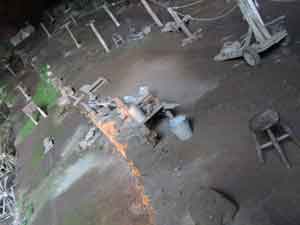
A vein of Blue John
Whilst on holiday in the Peak District last week, we visited some of the mines and caves of the Hope Valley. This is a cavern where the Blue John mineral is mined. One of only 2 mines in the area that still mines for Blue John.
Derbyshire Peak is the only place in the world where Blue John is found.
This photo was taken in Treak Cave.
There were some wonderful stalagtites and stalagmites, and fossils when we went on the cavern visit. We were encouraged to take photos......so I did!
Subscribe to:
Posts (Atom)